
📚 Southasia Review of Books - November 2024
📚 27 November 2024
Hello reader,
We’re back with a new episode of the Southasia Review of Books podcast! I had a great conversation with the Indian-Francophone writer Ari Gautier about his new short story collection Nocturne Pondicherry, translated from the French by Roopam Singh (Hachette India, June 2024), and his novel Lakshmi’s Secret Diary, translated by Sheela Mahadevan (Columbia University Press, September 2024). We talk about creolisation, Black and Dalit struggles, indentured labour, the little-known histories of French colonialism in South India and more.
Tune in to the episode on Spotify, Apple Podcasts or Youtube.
The Southasia Review of Books podcast will be available once every two weeks. If you like this episode, please share widely, rate, review, subscribe and download the show on your favourite podcast apps.
Listen to the full episode to catch Ari Gautier’s reading recommendations on Indo-French histories and cultures of Pondicherry.

📚 Reviews from Himal’s pages this month
📚 This month in Southasian publishing
Understanding Bhutan’s exile politics
The Ecosystem of Exile Politics: Why Proximity and Precarity Matter for Bhutan's Homeland Activists by Susan Banki (Cornell University Press, November 2024) relays the events in Bhutan that led to the mass deportation of its Lhotshampa population. Banki recounts the activism by Bhutan's refugee diaspora that followed. Banki explores how Nepal and India – sites close to Bhutan – can be spaces of risk and disempowerment where refugee activists rarely secure legal, political and social protection, while in distant diasporas in the Global North, they cannot tap into the advantages of proximity.
[Read Himal’s Founding Editor Kanak Mani Dixit’s three-part longform piece on Bhutan’s Lhotshampa question.]
The life and legacy of B R Ambedkar
Anand Teltumbde’s much-anticipated new book Iconoclast: A Reflective Biography of Dr Babasaheb Ambedkar (India Viking, November 2024) promises to go beyond the usual narratives often associated with B R Ambedkar’s legacy, to peel back the layers of myth and hyperbole and explore complexities of his persona and relentless pursuit of social justice, equality for Dalit communities.
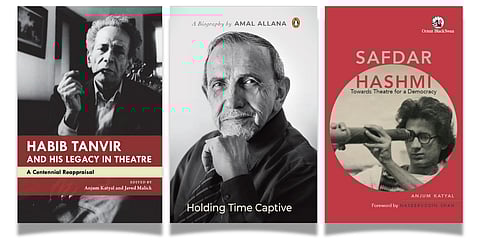
Major figures of India’s post-Independence theatre scene
Habib Tanvir and His Legacy in Theatre: A Centennial Reappraisal edited by Anjum Katyal and Javed Malick (Seagull Books, November 2024) delves into the legacy of a pioneer in post-Independence Indian theatre. Tanvir’s decades-long contributions as a director, poet, playwright, actor, his role in founding the Naya Theatre in 1959, and his fearless resistance against religious dogma and caste discrimination in works like Ponga Pandit are explored in this collection by a diverse group of scholars, practitioners and peers.
Amal Allana’s biography of her father, Ebrahim Alkazi: Holding Time Captive (Vintage Books, March 2024), is the first full-length account of the life, work and times of Ebrahim Alkazi, another giant of twentieth-century theatre and a promoter of the visual arts movement in India.
Also published this year, Safdar Hashmi: Towards Theatre for a Democracy by Anjum Katyal (Orient BlackSwan, May 2024) takes a close look at the firebrand artist, actor, playwright and activist’s role in the development of street theatre, and his group, Jana Natya Manch (Janam) as a leader in Indian political theatre. Also included in the book are the author’s own English translation of Janam’s most popular plays: Machine, Hatyare, and Aurat.
Literary festival season
The second edition of the Wayanad Literature Festival, India’s first and largest literary event outside its major cities, will be held on 27, 28 and 29 December. Arundhati Roy, Amitava Kumar, Dhanya Rajendran, Sanjay Kak, Dhirendra Jha and Benyamin among a fantastic lineup of writers, artists, filmmakers, journalists who will be in conversation. An academic conference, which hopes to address issues such as climate change and livelihood rights of farmers and indigenous communities, will be a significant part of WLF 2024. If you’re attending, say hello to Himal’s Editor, Roman Gautam!
The Rainbow Lit Fest, the largest queer and inclusive literary platform in Southasia, returns to Delhi on 7 and 8 December. Unlove Story by Sudipto Pal, translated by Arunava Sinha (Seagull Books, November 2024) will be launched at the festival. Described as one of the first openly queer novels written in Bengali, and the first to be translated into English, Unlove Story is an important addition to the canon of Southasian queer literature.
The fourth edition of the Green Literature Festival in Bengaluru – the only literary festival dedicated to celebrating environmental literature for all age groups in India – has announced the shortlist for the 2024 Best Green Book Awards, and will announce the winner on 7 December at the festival. [Read Meghaa Gupta’s essay from the Himal archives for more on GLF and enviornmentalism in Southasian children’s literature.]
The 13th edition of the Bangalore Literature Festival is set to take place on 14 and 15 December. They have also announced their shortlists for the 2024 Fiction and Nonfiction Book Prizes. The nonfiction category includes The Many Lives of Syeda X: The Story of an Unknown Indian by Neha Dixit (Juggernaut, July 2024), among other titles. In case you missed, tune in to our Southasia Review of Books podcast conversation for more on Neha’s book.
The New India Foundation awarded its 2024 Kamaladevi Chattopadhyay Book Prize to the writer Ashok Gopal for his biography, A Part Apart: The Life and Thought of BR Ambedkar (Navayana, April 2023). Huge congratulations to Gopal, who will be presented with the award at the Bangalore Literature Festival! [From Himal’s pages, read Harish S Wankhede’s essay on how A Part Apart and five other new reappraisals show the gulf between Dalit-Bahujan and anglophone writing on Ambedkar.]
Will you be attending any of these events? Are there any Southasian literary festivals happening in your city in December that I’ve missed? Write to me at shwethas@himalmag.com.
Until next time, happy reading!
Shwetha Srikanthan
Associate Editor, Himal Southasian